USI President Tells College Times Why It's So Important For Students To March Tomorrow
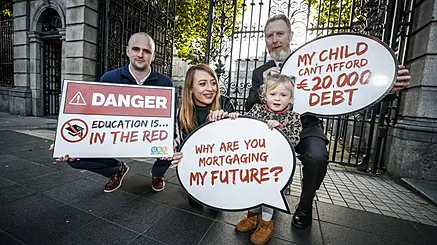
In anticipation of the USI March For Publicly Funded Education And Grant Investment, which is taking place tomorrow in Dublin, we interviewed USI President Michael Kerrigan, about the march's importance.
Q: Why have the USI called this march?
USI is demanding immediate action to be taken by Government to invest in publicly-funded higher education and for greater grant investment in Budget 2018.
The demonstration is expected to draw over 5,000 students. USI is calling on the Joint Oireachtas Committee on Education and Skills to make a historic long-term decision to invest in a publicly-funded third level education model, as outlined in the the Cassells report - a report published over 15 months ago on higher education funding.
Education is a public good and should be treated as such. Properly funded third-level education is the foundation of job creation, social equality, and a thriving economy. Meaningful investment in higher education is necessary if we are to meet a myriad of state objectives, such as having a highly skilled workforce which will subsequently attract foreign direct investment, or to be a country which is world-renowned for research and innovation.
The third-level sector has struggled to perform during many years of austerity. USI believes that the sector should be praised for its efforts to deliver a quality education during a sustained period of under-investment and uncertainty. However, what is necessary as a response to crisis is not sustainable as a long-term model. It’s time to match talk of economic recovery with strategic investment in this essential public service.
It is estimated that it would take up to 17 years for an Irish student loan scheme to become self-financing. ‘Investing in National Ambition’ cites Chapman (who introduced loans in Australia) in estimating that €12-13m will be lost every year because of non-payment of graduate debt by emigrants.
America’s student loan debt ($1tn+) is greater in value than the combined economies of Ireland, New Zealand, and Australia.
Q: What are the USI hoping to achieve with the march?
We hope to see up to 5,000 students take to the streets alongside representatives from trade unions like the Teachers Union of Ireland (TUI), SIPTU, Irish Federation of University Teachers (IFUT), IMPACT and the Irish Second-Level Students Union (ISSU). We hope to see income contingent loans taken completely off the tables in Budget 2018, and for further investment into the sector along with a greater investment into grant supports for students. As a longer term goal, USI hopes to see government commit to reducing the €3,000 student contribution fee, which will soon be the highest 3rd level fee in the EU.
Q: How would an income contingent student loan scheme negatively affect students?
An income-contingent student loan outlined in the Cassels report is a drastic increase in fees from €3,000 to €5,000 a year with the SUSI grant no longer covering it for any students. The moment we accept higher fees and a loan scheme, we are saddling people with at least €20,000 of debt as they start life as a graduate.
An income-contingent student loan will be unsustainable and will devastate communities, pushing the best and brightest to emigrate. USI fears graduates would be pushed out of the housing market as evidence from New Zealand shows that 51% of banks that received applications from clients with student debt had indicated that student loans were the contributing factor in rejecting finance - with 34% of those likely to be rejected being mortgages.
International evidence has shown that ICL scheme have a negative effect on access and have led to drastic declines in the number of mature students, students with disabilities, lone parents and students from lower socio-economic backgrounds attending 3rd level.
Q: How important do you feel marching and other forms of activism are for influencing change?
They are very effective. However, there must be a good mix of different levels of activism. Marching and protesting can be seen as just shouting into the void, and people believe that it’s having a seat at the table or face-to-face with policymakers and politicians that makes a difference. I feel it’s a blend of the two. Marches and public agitation on a grand scale shows the mettle behind your words when you lobby a TD or Senator. You have thousands of people behind you. When you walk into the room, the thousands of voices from a march are echoed through your own voice when lobbying.
Q: Do you think that perceptions of Ireland's third level institutions are being negatively affected internationally due to a lack of funding?
Irish colleges are slipping down the rankings. Colleges need an additional annual funding of €600 million by 2021 and €1 billion by 2030 to deliver higher quality outcomes and provide for increased demographics. 10 of 14 Institutes of Technology are in serious financial difficulty. Our third-level sector is crumbling before us and we can’t allow this failure to fall down on students’ heads.
At €3,000 Ireland already charges the 2nd highest rate of fees among EU countries in the OECD to those who do not qualify for a fee waiver through the maintenance grant scheme. Student enrolments have drastically increased due to encouraging unsustainable student recruitment for struggling academic units. This effect has been amplified by a strengthening tradition of direct transition between second and third-level and the under-resourcing of the further education and training sector.
The consequence of these developments is that the Irish higher education system is struggling to perform. In 2009, the majority of European countries reported either increased or stable higher education budgets as compared to the academic year 2008/09. However, several countries introduced budgetary cuts. In the EU, these cuts were most severe in Ireland, Latvia and Iceland.
In 2010/11, the majority of European countries increased spending on higher education. In only six countries national higher education budgets have decreased. Among these Ireland, Italy and Iceland registered a second decrease in public funding. Education authorities in Ireland and Iceland persist with particularly significant budgetary cuts in the range of 8-10 per cent per year. With the economic crisis and cuts, Ireland, Greece, Italy and Iceland allocated special funds to ring fence the sector from the most severe effects of the crisis.
Q: Beyond a reduction in fees, what else do you think the government can do to help students, say regarding the current housing crisis in Dublin?
The average cost of college is €12,500, and USI research shows 75% of students pay for their own accommodation during term time, while 58% of students declared the monthly cost of accommodation of €251-500. Half of them have an income not exceeding €500 a month. The cost of accommodation is proving difficult for students, and the cost of rent is leaving no money for food, travel or books. Our report also states that 2% of respondents pay over €1000 a month for their accommodation. In terms of deposits, 36% students do not get receipts for their deposits with €400 being the average for a deposit.
Some of our ideas on housing include adjusting the rates of third-level grants, postgraduate grants and student assistance fund to reflect the real costs of participation in higher education, including accommodation costs. Decrease the grants adjacency rates of the grant from 45km to 25km. Since January 2011 there has been a 3.8% increase in Ireland’s CPI (CSO, 2017) and the annual rent inflation amounted to 13.5% in the final quarter of 2016 (Daft, 2017). Despite the increases, the Government reduced the grant by 4% and a further 3% in 2012, which has had a negative impact on students’ finances and reflected on the affordability of their accommodation.
Q: For students who are unable to attend the march, are there any other ways they can lend support to this cause?
Get in touch with your local TD now. Services like https://www.whoismytd.com/ are useful to find out who your local TD, or councillor is. Ask them to support USI’s asks in Budget 2018 (which can be found on usi.ie/usi-budget-2018/.
Get on social media and show support using #EducationIs and tag your TDs in any posts you’re making.
Register to vote. Check www.checktheregister.ie and see if you can vote. If not, get registered because if you don’t have a vote, you may as well not exist in the eyes of local TDs. Having a vote gives you power of influence.
The march will be taking place at 1pm from Custom House Quay in Dublin, with crowds expected to start gathering from 12.